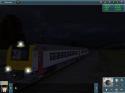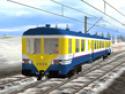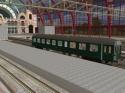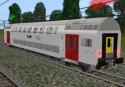


NMBS AR41
130544:1004:2
130544:1005:2
NMBS AR45
130544:4502:5
130544:4503:6
130544:6052:4
130544:6053:4
130544:60501:5
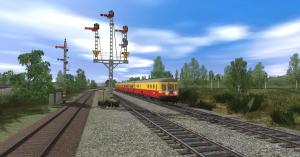
The diesel railcar (autorail in French) of class 670 was the last in a line of series, some very small, of streamlined multiple-unit diesel trains. The development was stimulated by the successful application of diesel streamliners as long-distance trains in the neighboring countries, France, Germany and The Netherlands. The development had only hardly begun with the first sets of two-car class 651 and 652.0 built in 1934 and later series 652.1 (two-car, later 620), 653.0 and 654 (three-car) built around 1938, when it was seriously interrupted by WWII.
Based on the experiences so far, some changes in the design were made, which led to notable differences between class 670 and the earlier models. The common bogeys between the cars were gone; each car rests on its own two bogeys. This improved the riding quality and made maintenance a lot easier. Furthermore, the intermediate coach was longer and the engine units were shorter than in their predecessors, in order to offer more passenger space free of the noise and vibrations of the engines.
Six units were built and initially delivered as class 653.1. In WWII, the set 653.12 lost one engine unit. The other five sets were either undamaged or underwent repairs; they would receive the numbers 670.01, 670.03, 670.04, 670.05, and 670.06. Set 653.15 had to be rebuilt with different engines due to a shortage of parts, however, and it actually received the number 671.01. After a fire during service that destroyed two cars of the 670.03, the two idling cars of 653.12 were combined with the remaining engine car of 670.03 and the mixed set received the number 670.02. After a revision of 671.01 in 1961, in which it received the original type of engines from a 653.0 set taken out of service, it was accidentally renumbered 670.03 instead of 670.05!
The trains have done their services out of Brussels South, out of Ronet and out of Kortrijk. In 1964-1965, when they were based at Kortrijk, they even served Tourcoing in France.
The railcars ended their service in 1965-1966.
The Trainz model has the livery that corresponds to the final appearance of the trains, with two headlights and painted a single tone of green.
Each of the seven numbers that have appeared on the real engine cars can be made to appear on the front and in the cab by means of the Edit Details menu in Surveyor 2 or through the '?' option within the Trains foldout in Surveyor Classic.
The engines can be started by means of the pantograph icon on the user interface in DCC and Realistic Mode, or with the driver command HP Start Engines.
A separate video is supplied to demonstrate how to turn a cab into the control cab, start the engines and drive the train from the cab in Realistic Mode.
The throttle has 10 positions which are accessed in two sets of five positions, corresponding to the action of either one or both of the two torque converters of the hydraulic transmission.
The TELOC speed instrument has a small button on the top, which will RESET the script (and stop the train).
176753:2005001
176753:2049007
176753:2049008
176753:2026004
176753:2049004
176753:2023212
176753:2022202
176753:2022201
176753:41010
176753:2049005
176753:2023213
176753:2049001
176753:2020201
176753:2049003
176753:2023211
176753:2020203
176753:2049002
176753:2020202
NMBS I10
130544:15103:1
130544:15104:2
130544:15105:1
130544:15106:1
130544:15107:1
130544:15108:1
130544:15115:1
130544:15116:1
130544:160000:2
NMBS I11
130544:7587:1
130544:7588:1
130544:7589:1
NMBS K1
130544:15043:2
130544:15044:3
130544:15045:2
130544:15046:2
130544:15047:2
NMBS M6
130544:15001:8
130544:15002:8
130544:15003:8
130544:75830:5